
Log homes take the mountain sun harder than anything else we stain.
Bare logs gray, check and open up fast above 8,000 feet. Getting a stain to last starts with removing what the sun already damaged.
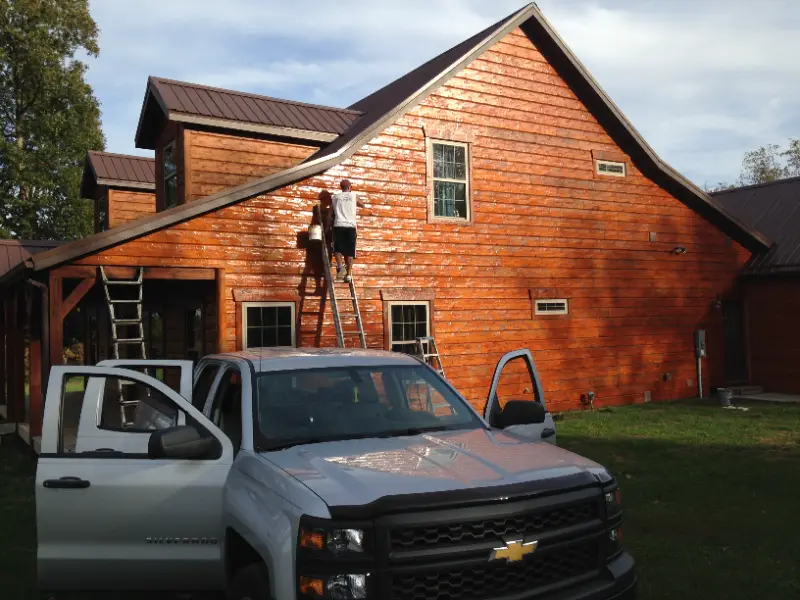
Log home staining protects exterior logs and cedar siding with a pigmented, penetrating or log-specific finish. In Colorado's mountains the main enemy is ultraviolet light, which is stronger at altitude and breaks down the surface of the wood, followed by snow, freeze-thaw and wind-driven moisture getting into upward-facing cracks. A lasting job removes the gray, weathered surface first, seals checks and chinking, and uses enough pigment to block the sun. Painter Hotline stains log and cedar homes in Summit County, Clear Creek County and the foothills, with free written estimates from photos.
What the sun actually does to a log
Wood is made mostly of cellulose held together by lignin. Ultraviolet light breaks down lignin at the surface, which is why unprotected logs turn gray: the surface fibers have been loosened and are washing away a little at a time. The USDA Forest Products Laboratory, which has studied exterior wood finishes for decades, describes this weathered layer as a poor base for any finish. Stain applied over gray, loose fibers fails with them.
Altitude makes it worse. The U.S. EPA notes that UV levels rise about 6% per 1,000 meters (about 2% per 1,000 feet) of elevation, and towns like Breckenridge, Frisco and Dillon all sit above 9,000 feet. South and west walls take the most sun and almost always fail first; the bottom courses take snow splash and meltwater; logs under deep overhangs can look new after a decade.
Stain, not paint, and why pigment matters
Logs move. They shrink and swell with moisture, they check (crack along the grain) as they dry, and they need to release moisture outward. A thick paint film cannot follow that movement and traps moisture behind it, so most log homes are finished with penetrating stains or with finishes made specifically for logs.
- Clear and lightly tinted finishes look beautiful at first but have little to stop UV. In full mountain sun they weather fastest.
- Semi-transparent penetrating stains soak into the wood and carry enough pigment to block much of the sun while still showing grain. Forest Products Laboratory research has long favored pigmented penetrating stains for weathering exposure.
- Log-specific film-forming systems build a flexible coating, often with a separate clear topcoat. They can last well when the wood was properly prepared, but once they start to peel they have to be removed, not just recoated.
The trade-off is always the same: more pigment means more protection and less visible grain. We help you choose where that line sits for your house and your exposure.
Preparation is most of the job
On a log home the staining itself is the short part. Preparation decides whether the result lasts:
- Removing the old finish and the gray. Depending on what is on the logs, that may be media blasting (for example with crushed glass or corncob), sanding, or chemical strippers followed by a wash. The goal is clean, bright, sound wood.
- Careful washing. High pressure raises the grain and drives water deep into checks and joints. We use cleaners and controlled pressure, then let the logs dry.
- Checking moisture before staining. Stain manufacturers specify how dry the wood must be. We measure rather than guess, because stain over wet logs does not penetrate.
- Repairing soft or rotted wood before it is finished over, and telling you plainly where a log needs a carpenter rather than a stain.
Checks, chinking and caulking
Upward-facing checks wider than a hairline act like gutters: they catch rain and snowmelt and lead it into the log. Those are sealed with flexible log-home sealants made to stretch with the wood. Chinking and caulked joints between logs are inspected for gaps and adhesion loss, and repaired with compatible products and backer rod where needed. Air and water leaks at joints are a comfort problem as much as a finish problem, and they are cheapest to fix while the walls are already being prepared.
Keeping it from getting this bad again
The cheapest log home finish is the one you maintain before it fails. A simple routine:
- Walk the house each spring, starting with the south and west walls.
- Splash water on the logs. If it beads, the finish is working. If it soaks in and darkens the wood quickly, that wall is due.
- Recoat the worst elevations with a compatible maintenance coat before they gray, which avoids stripping later.
- Keep snow, firewood and soil from sitting against the bottom courses, and keep gutters and downspouts clear.
Scheduling around a short season
Every stain has minimum surface and air temperatures on its data sheet, and the wood has to be dry. At elevation, cold nights and afternoon storms shorten the working window, so mountain exterior work fills up early. If your logs are graying now, getting on the schedule over the winter is the easiest way to get a good summer slot. Meanwhile, decks are handled by our deck and fence crew and can be done in the same visit.
What moves the price
We do not publish a per-square-foot figure for log homes because condition varies so much. The factors that move a quote are:
- Wall area, height and access (ladders, lifts or scaffolding).
- Condition: a maintenance coat on sound finish versus stripping gray or peeling wood.
- The removal method the existing finish requires.
- Check sealing, chinking and caulking repairs.
- Product choice and number of coats.
Where we stain log and cedar homes
Summit County, including Breckenridge, Frisco, Dillon and Silverthorne; Clear Creek County, including Georgetown; and Conifer. See where we work for the full area.
Log home staining questions
Why are my logs turning gray?
Ultraviolet light breaks down lignin at the wood surface, loosening the fibers, which then weather away. The effect is stronger at high altitude. The gray layer should be removed before staining, because stain applied over it fails along with it.
Should I paint or stain a log home?
Stain, in almost every case. Logs shrink, swell and check, and need to release moisture. Penetrating stains and log-specific finishes allow that; a thick paint film tends to crack and trap moisture.
How often does a Colorado log home need staining?
It depends on exposure, product and how well the surface was prepared. South and west walls usually need attention first. Check every spring: if water soaks in and darkens the wood instead of beading, that wall is due for a maintenance coat.
What is the best way to remove old stain from logs?
It depends on the existing finish. Options include media blasting, sanding, and chemical strippers followed by a controlled wash. The aim is clean, bright, sound wood without driving water deep into the logs.
Do you seal checks and repair chinking?
Yes. Upward-facing checks that can hold water are sealed with flexible log-home sealants, and chinking and caulked joints are inspected and repaired with compatible products as part of the preparation.
Can log homes be stained in the mountains in spring or fall?
When the wood is dry and temperatures stay within the stain manufacturer's limits. At elevation that window is shorter, so mountain exterior work tends to book early.
Tell us about the project
Photos and the year your building went up usually get you a written number within a day. If yours really needs a visit, we will tell you.
Prefer to talk it through? 720-208-5645