
The crew that keeps wood from becoming a lumber bill.
Sealed on schedule, a deck is maintenance. Left too long it turns into carpentry, and Colorado sun gets there faster than most homeowners expect.
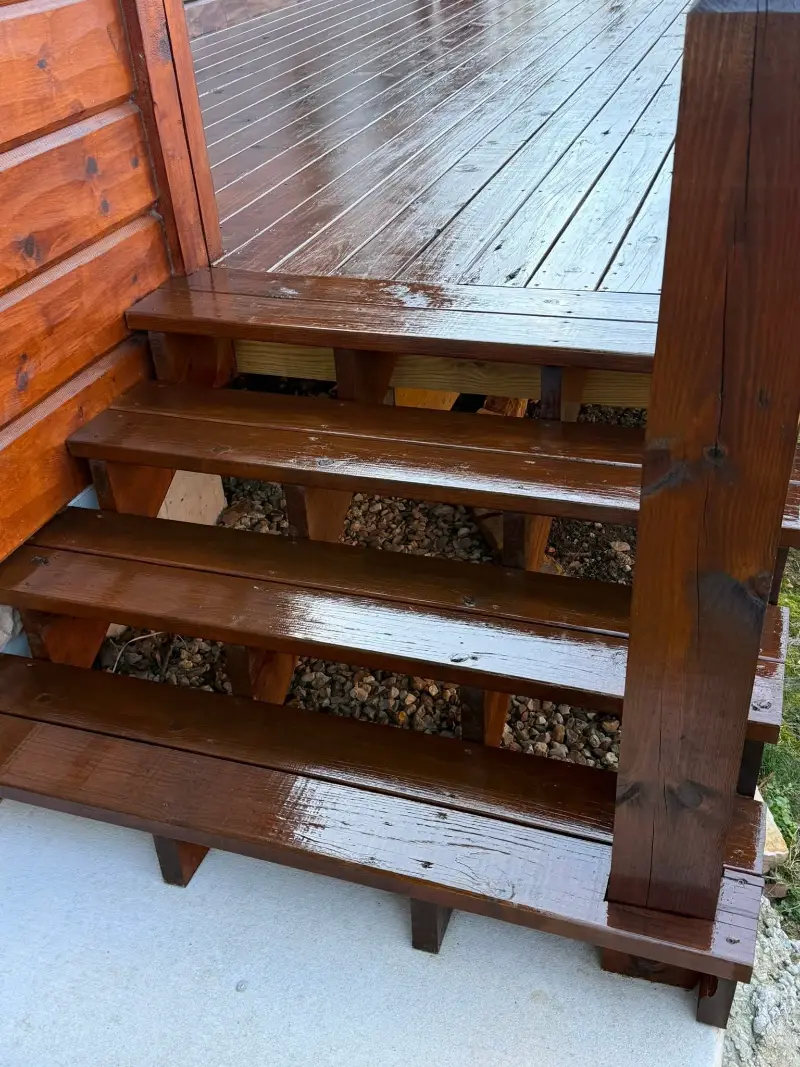
The Painter Hotline deck and fence crew stains decks, fences, railings, pergolas and timber across Colorado. Each job starts by stripping off the gray, sun-burned surface fibers with a cleaner, then a brightener to rebalance the wood, sanding wherever the grain stands up, and a penetrating stain picked for high-altitude sun and repeated freezing. We keep paint off walking surfaces: on boards that hold snow and get walked on, a surface film eventually peels.
The ten-second test
Splash some water on the boards that get the most sun. Beads that sit on top mean the finish is still working. Water that disappears into darker wood means the boards are drinking every storm and every melting snowbank, and cracking and splintering are next.
In Colorado that moment arrives sooner than people expect. A sun-exposed deck here often needs attention in two to three years where a shaded one under mature trees might go four or five.
Three steps before any stain
- Clean. Remove the gray surface layer, mildew and old failing product. Gray wood is UV-damaged fiber, and stain applied over it bonds to a layer that is already letting go.
- Brighten. Deck cleaners are alkaline and leave the wood chemically unbalanced. A brightener restores pH so the stain penetrates evenly instead of blotching. This is the most commonly skipped step, and it is why some deck jobs come out patchy for no visible reason.
- Sand where needed. Cleaning raises the grain. Sanding knocks it back so the surface is smooth underfoot and the stain goes on uniformly.
Stain, not paint, on anything horizontal
Paint sits on the surface as a skin. Under boots, snow and puddles that skin cracks and lifts in patches, and the only real fix is stripping the whole deck. A penetrating stain soaks in and simply wears thinner over time, so the next round is a wash and a fresh coat instead of a strip job.
So if you ask us to paint the deck floor, expect us to argue for stain first. Railings and skirting are a different story.
Choosing a transparency
| Type | Grain | Cycle | Best for |
|---|---|---|---|
| Transparent | Fully visible | Shortest | New cedar or redwood worth showing off |
| Semi-transparent | Mostly visible | Medium | Most Colorado decks. The practical default |
| Semi-solid | Texture only | Longer | Older wood with uneven color to even out |
| Solid | Hidden | Longest look | Fences and weathered wood. Hardest to undo later |
Log, timber and mountain property
Higher up, logs and timbers are their own job. Logs open long drying cracks called checks, and checks that face up hold water and rot from the inside. Upward-facing checks and any chinking get dealt with in the scope, not skipped for the sake of a quick coat.
Our other crews
Deck and fence questions
How often does a Colorado deck need new stain?
Go by the water test, not the calendar. Once water soaks in instead of beading, recoat. On the Front Range, decks in full sun often reach that point in two or three years.
Why did my last deck stain peel?
Most often one of three things: a product that forms a skin was used on the walking surface, the wood was still wet when it was coated, or the new stain went over an old sealer and never soaked in. Each one traps moisture under the finish.
Should I paint my deck instead?
Not on the boards you walk on. Paint peels there and has to be stripped later, while stain wears down evenly and is easy to renew. Painted railings and skirting can work well.
Should I stain a new deck immediately?
Not always. Fresh pressure-treated boards are often too wet to take stain, and how long they need depends on the wood and the season. We measure the moisture before deciding.
Do you work on log homes?
Yes. Logs and big timbers get penetrating stain, care for checks and chinking, and products made for mountain sun. The log home staining guide walks through how we prep and seal them.
What about boards that are already rotten?
Loose boards, raised screws and soft spots get marked during the estimate. Small fixes are part of the job; bigger carpentry gets its own line and price.
Tell us about the project
Photos and the year your building went up usually get you a written number within a day. If yours really needs a visit, we will tell you.
Prefer to talk it through? 720-208-5645